
At the May 26 Mayor & Council meeting, we voted to approve the City’s budget for the 2027 fiscal year, which started on July 1st and goes until June 30, 2027. The budget vote came after a series of earlier votes that set the tax and utility rates and various fees.
I think we came out with a solid budget that appropriately allocates money to the fundamentals, particularly street paving, sidewalks, trash pickup, and water and sewer infrastructure. We did it without increasing the City’s portion of the property tax rate, though, as in years past, we did raise utility rates and fees. The overall fee and rate increase was modest, however, and smaller than last year’s. Each of those votes were unanimous, so I’ll focus on explaining the main points of the budget as I see it and my considerations in approving it.
Operational Budget and Trash Collection
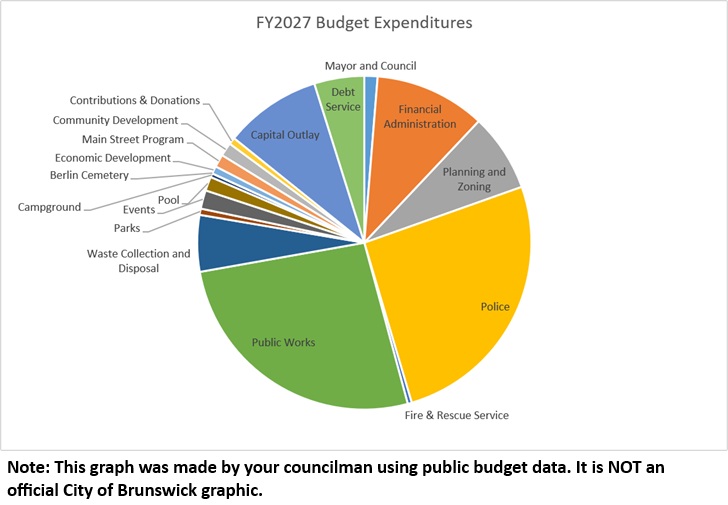
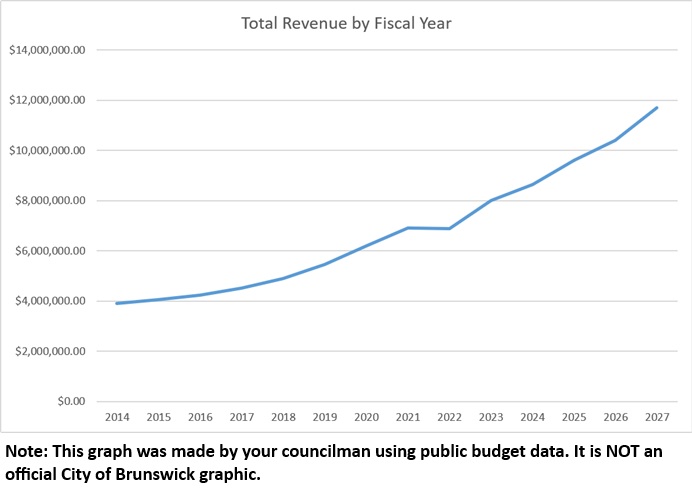
To start with, Brunswick’s tax base continued to grow as the last few parts of Brunswick Crossing were being built out. Overall revenue for the general fund (which is everything except water and sewer) was $11.6 million. That’s about $1.2 million more than last year’s budget. Tax revenue was $7.6 million, up by $1.1 million from last year. This helps us meet expenses without having to raise the tax rate, which remains at 41 cents per every $100 of assessed property value.
Most of that $11 million in revenue goes into operating costs: staff salaries, pensions, supplies, insurance, etc. Like last year, this budget included a 2% across-the-board cost of living adjustment (COLA) increase to staff salaries (we later made another change to police salaries, which I’ll explain in another post). Doing these small adjustments annually helps Brunswick stay competitive in the municipal hiring game and keep us from having too much staff turnover.
Trash collection is also part of the general fund’s operating budget. It costs $641,500 this fiscal year. As I’ve mentioned before, for the last several years that cost has not been fully covered by what we pay in our trash bills. Two years ago, the City had to fund about $250k of it through general taxation, which resulted in less money being available for other public services. Last year, we contracted with a new trash company and rose the rate by $2.25 per quarter (for a $37.25 total quarterly bill), which got that deficit down to $125k. This year, we got the deficit down to $100k by increasing the rate by $3.25 (for a $40.50 bill).
How come it took a bigger rate increase to drop the deficit by $25k this year than it did to drop it by $125k last year? That’s because the City saved money on its trash contract by switching to the new company last year, allowing us to cut the deficit by a lot while only raising the rate a little. Now that last year’s savings on the contract have already been factored in, the bill we pay has to do the rest of the work of closing the deficit.
That’s why we opted to bring down the deficit by the smaller amount of $25k this year instead of dropping it all the way to zero. Doing that would have required something like a $16.25 increase, meaning a quarterly bill of $53.50. The consensus was that it was better to raise the rate gradually.
Even so, the additional $25k of the trash cost that our bill payments will now cover will still make a difference. That’s because it will allow $25k of what we pay in property taxes to go to things like paving, which I’ll turn to next.
Capital Budget
The capital budget is for major projects and infrastructure/equipment maintenance. We set aside nearly $1.1 million in general fund revenue for the capital budget this year, compared to about $655k last year. That means more money for the physical upkeep of our town: fixing roads and taking care of public places and buildings.
In particular, I’m glad the budget includes $500k for street improvements, compared to $300k last year. Few things are more of a pain for residents and give a worse impression to visitors than bad roads, and proactively funding paving is how we avoid that. To the layman’s eye, like mine, Brunswick’s streets now seem mostly ok. But I understand from our public works professionals that issues beneath the surface can add up and deteriorate quickly, and we’ll find ourselves far behind the eight ball if we wait for problems to get obvious. My understanding is that sustaining the paving budget at $500k will allow us to keep a handle on things, and I intend to push for that. This year is a good start.
The capital budget also contains $95k for a pavement patching machine, which I was skeptical about at first. We’ve all seen towns that use those as a substitute for regular paving, and where the roads are a spiderweb of patched cracks and potholes. But I’ve been convinced that the patcher can slow a road’s deterioration by preventing water from getting in cracks. That makes repaving the road less expensive when it’s due. So, the machine is worth its cost. It’ll be on us—the Mayor & Council, City administrative leaders, and the voters—to make sure we budget enough for paving and resist the temptation to lean on the patcher more than we should.
The budget also allocates $110k to fixing the retaining wall for the Martins Creek parking lot (the one across from Potomac Street Grill) and $35k for culvert replacements, plus roughly $223k for maintenance of public buildings and the City’s vehicle fleet. It also sets aside $66k for the City’s reserves.
Now, the above items basically account for the $1.1 million moved over from the general budget, but the capital budget itself amounts to $5.3 million. That’s because the other items use grant money and/or proceeds from the bond the City took out last fall.
There are two grant-funded sidewalk projects for about $521k combined: design for East H Street and construction for the upper part of North Maple Ave, both of which I wrote about in my recent post on sidewalks. Another $221k in grants is going to maintenance for the playgrounds in Galyn Manor and on 2nd Ave. The remaining roughly $3.6 million is allocated to the sports complex on 13th Ave, which last I checked remains on track to be finished sometime this fall.
Water and Sewer Budget
That leaves the enterprise funds (water and wastewater). There are a few things I’d like to point out here.
First, we continued the policy adopted by the council in 2024 of raising in-town water and sewer rates gradually but predictably by 2-3% each year. This year, we rose the water rate by 2.5% and the sewer rate by 3%.
The reason for sewer being a bit higher is because its operating costs have been higher. The budgets for both water and sewer are balanced when you factor in grant money, connection fees, and bond proceeds. But if you strip them down to just service charges minus operating costs and debt service—which are the most consistent revenues and expenses—the wastewater fund dips about $90k into deficit. That doesn’t mean a crisis (thanks to those other sources of funds), but it does show that we need to plus up the sewer system revenue a bit.
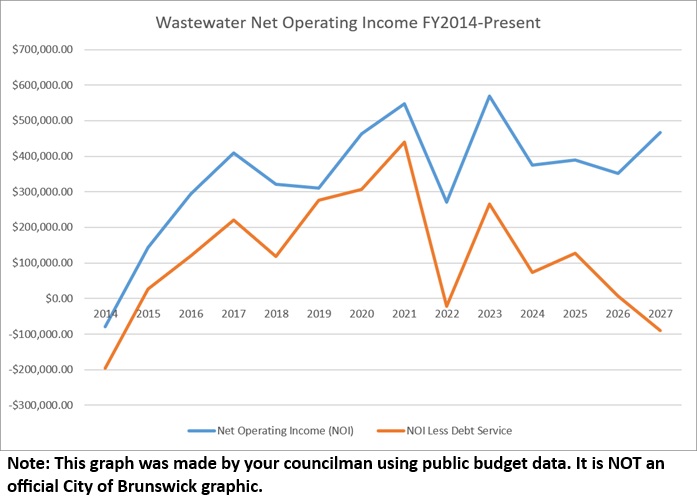
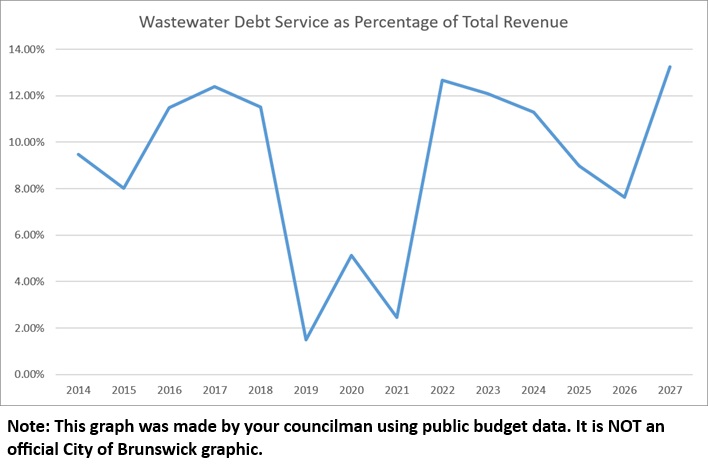
Debt service for both the water and wastewater funds has gone up as a proportion of their total budgets, which we knew would happen when we voted to approve the bond (technically, a bond anticipation note) last fall. The good news is that City Hall anticipates having to convert only about a third of what we borrowed into a long-term bond, and we’ll probably be able to pay off the rest within five years. That means the debt service cost may well go down sooner than the top-line figures would suggest.
The new equipment that we are using the bond to buy should also make operating the water and sewer plants more cost-effective. So, even though inflation in the cost of things like chemicals over the years likely means that the water and sewer rates won’t drop below what they are today, the outlook is pretty good for keeping future increases gradual and predictable.
I’ll also point out a few of the major water and sewer infrastructure projects going on this fiscal year. We’ve got almost $1.3 million in grant money for a new storage tank at Yourtee Springs, which will make that water source more productive. That’s important, because water from Yourtee is less expensive to treat than water from the Potomac. There’s $524k in state grants for replacing the reservoir near Souder Road, which I’ve talked about before. There’s also another $553k in state money for connecting some of the remaining houses in town that use septic systems to our municipal sewer. All are worthwhile things.
Water and Sewer Infrastructure
Also related to the water and sewer funds: We rose the system improvement fee slightly, from $50 per year to $60. It’s an annual flat fee that you can see on the tax bill the county mails out each year.
I wrote about this fee when we set it last year. It dedicates revenue to water and sewer system improvements and sidewalk projects, but without tying it to property values so that it doesn’t increase unpredictably when property assessments go up. Currently, $30 of it is set aside for sidewalks, $20 for water infrastructure, and $10 for sewer infrastructure. I’ll use the water part of it to illustrate how it makes a difference.
For at least the past 12 years, and probably longer, Brunswick has only budgeted 20% of “depreciation.” Depreciation in this context is a calculated figure. In theory, if the City budgeted for 100% of depreciation, we would have enough money in our reserves to replace major water and sewer equipment when they reach the end of their service life.
Inflation can throw that calculation off in practice, and there’s a decent argument not to budget 100% of depreciation and have that money lying around in reserves instead of being put to use for more immediate needs. But looking at what percent of depreciation we are budgeting for is still a useful way to measure how much we’re saving for replacing old equipment.
This year, the City is expected to collect about $74k from the water portion of the system improvement fee, which will go into our reserves along with the 20% of depreciation that is normally budgeted ($170k). If you add those up—because they are both saving money for infrastructure—we will actually be budgeting about 29% of the depreciation figure instead of 20%. That sounds nerdy, but it means that we’ve substantially upped the amount of money we’re saving to replace our water and sewer equipment for the first time in more than a decade.
What that means in practical terms is that we’ll have to take on less debt next time we need to replace something like the sludge press at the wastewater plant. Since the cost of servicing our debt makes up a big chunk of the City’s water and sewer expenses now (11% for water and 13% for sewer), that matters. Less debt means that less of our water bill has to go to paying for things in the past and more can go to paying for things in the present—or for the future.
Because debt comes with interest, what this all comes down to is that we pay a bit more now so that we won’t have to pay a lot more later.
Summing Up
So, to sum up: There’s solid funding for the basics in this budget. It doesn’t come free, but the budget aims to limit the burden on citizens. There are fee and utility rate rises, but no property tax increase. The increases we have are gradual, and their total amount is smaller than it was last year.
By my calculation, in fiscal year 2026, a household that uses between 11,000 and 12,000 gallons of water every three months—roughly in the middle of the pack for water use—would have seen their total City charges and fees go up by $88 compared to the previous year. In this fiscal year (2027), I calculate that the same household would see a total increase of $56. If (like me) you use more water than that, the numbers would be a bit higher, and if you use less water they’d be a bit less. What holds steady is that the total increase this year is about a third less than last year’s.
Every dollar still adds up, though. There are cost-of-living factors that are outside our control but still affect everyone. Gas prices have been a roller coaster this year, for instance. If they turn out to have been consistently high by the time we get to next spring, I’ll be thinking of that when we set next year’s rates and fees. I should acknowledge, though, that rising external prices cut both ways: They tighten our personal budgets, but they also raise the cost of providing public services and maintaining infrastructure.
Looking ahead, we have some big expenses on the horizon. The most immediate one will be overhauling our police pension system, which I’ll write about in my next post. As I mentioned at the beginning, the fact that our tax base has been growing helps with taking those costs in stride. Even as the build-out of Brunswick Crossing wraps up, we can expect Brunswick’s tax revenue to keep growing as the two new 55+ developments get built over the next few years.
Residential growth isn’t the solution to everything, since it also requires us to expand existing services. It does help to keep the budget healthy if we use the additional tax revenue to make improvements in quality along with quantity, like we are doing at the wastewater plant.
Economic development helps, too. Commercial and industrial properties often generate more tax revenue than houses. That said, the recent county primaries and the data center referendum push seem to show that there are fairly tight limits on what people in Frederick County, and I reckon Brunswick too, are willing to accept right now in terms of industrial development.
I understand the reasons for that, and I ran in 2024 in part on pacing ourselves with development. But we have to realize it comes with a tradeoff: With fewer things like data centers and factories generating tax revenue, more of the burden for maintaining public services and infrastructure falls on residents and small businesses.
So long as we keep that tradeoff in mind, though, I reckon we’ll be okay. Economically, things are still looking promising in Brunswick. We’ve had a lot of new businesses open in the past two years. That includes businesses both downtown and on large properties up the hill, such as the collision center on Maple Ave and the distillery getting ready to open on 5th Ave. They’ll all make a valuable contribution to our community’s public finances, and more are likely to come.
Meanwhile, our City employees remain proactive at applying for state and federal grants. Grants are no longer quite the bonanza they were after Covid, but they haven’t dropped off as much as I’d feared. As a result, we’ve been able to make necessary investments in infrastructure and services so far with what are, at the end of the day, relatively limited and gradual rate increases.
I felt satisfied that this year’s budget serves the interests of our community, and I’m confident we can continue that trajectory whatever the next few years throws at us.
You can find the budget here.
You can watch the mayor’s budget presentation here (at the beginning).
You can see the table of rates and fees on page 5 of the April 28 Mayor and Council agenda here.
You can watch our discussion of the trash rate in the video of the March 24 meeting (starting at about 45:50).
You can watch our discussion of the system improvement fee in the video of the March 24 meeting (starting at about 34:09).