
It’s taken me a while to get to this, but at the July 28 Mayor & Council meeting I offered several amendments to Ordinance 632, which set standards for Accessory Dwelling Units (ADUs) in Brunswick. Three of my amendments were adopted in full, one passed with some modification, and one failed. I want to lay out my thinking on them because I reckon many of these questions about ADUs will come up again.
First, some background: ADUs are basically small apartments that a homeowner builds on his or her property—think in-law suites. They can be additions to the existing house (an attached ADU) or they can be built as a separate structure somewhere else on the property (a detached ADU), like a standalone garage.
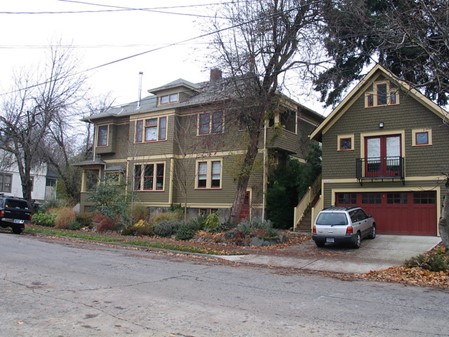
The Maryland General Assembly passed a law that required all local governments to allow ADUs by October 1st of this year, but it gave us some leeway to regulate them. That’s what this ordinance does. The original draft was presented by our Planning Department at the June 9 council meeting, and our newly-formed Housing Advisory Committee looked at it in July and gave some feedback.
The first amendment I proposed was a minor edit clarifying that ADUs have to meet the setback requirements (the distance from the property line) already established for the lot and zone the property is in. This had been something our planning folks wanted to add, and I agreed to include it with my other amendments. It passed easily.
The next amendment had to do with how much of the property could be covered by impervious surfaces after building an ADU. Impervious surfaces are roofs or pavement or other things that rain can’t pass through to get into the soil, so they cause stormwater runoff. The original draft prohibited impervious surfaces from covering more than 50% of the lot after the ADU is built. My amendment tightened this up a bit so that they can’t cover more than 40%.
I did that because we’ve had some longstanding issues with stormwater runoff in the older part of town, and we should limit the risk of exacerbating them. Some residents have also voiced concern about runoff from new developments. While new developments’ stormwater management systems ought to be able to handle their anticipated runoff, being conservative with the impervious area limit will help avoid a scenario in which ADUs cause more runoff than was planned for when those systems were designed. That amendment passed unanimously.
The third amendment was prompted by input from an advisory committee member. The original draft prohibited ADUs from being used for commercial purposes, but the member pointed out that it also seemed to ban home occupations that don’t cause any disruption to the neighborhood (think someone self-employed with an online IT business). My amendment used language recommended by the planning staff to allow no-impact home-based businesses and remote work in ADUs, so long as it’s the person living in the ADU who is doing those things. It also passed unanimously.
Parking Requirements
The fourth amendment I proposed had to do with parking requirements. The draft ordinance required a property to have at least three off-street parking spaces to build an ADU (counting existing spaces). It also allowed the City to grant waivers to reduce the number of required spaces, which is mandated by the recent state law. Those waivers would have to be approved each time by the Mayor & Council.
I thought it was important to have the conditions for approving waivers spelled out in the ordinance, so that’s what my amendment did. It only allows a waiver to be granted if building additional off-street parking on the property is infeasible or if building those extra spaces would cause the lot to bust the 40% limit on impervious surfaces. If that’s the case, then it basically allows the City staff and council to take into account street parking spaces that are directly in front of the property. Those on-street spaces could then count toward the required three.
So, for example, if you have a hillside property where it’s not feasible to build an extra parking space, you might get a waiver if you have one space already in your driveway and enough room for two cars in the street in front of your house. Or if you have a little bit of room to widen your driveway, you might get a waiver that requires you to build just one additional spot so long as you have enough room on the street in front of you to park a car. The goal is to make it possible for people to build ADUs in the parts of town that are geared towards street parking, but to do it in a way that limits the pressure on street parking overall.
I also wanted to empower the City Administrator to sign off on waivers instead of requiring them all to be approved by the council. The mayor and several of my colleagues disagreed with this, partly on the grounds that council approval fits the precedent of other things we do. They have a point: for example, the council approves event applications that meet certain conditions. And it’s true that the Mayor & Council is the ultimate decision-making body in our town government.
But as a general principle, I think it’s better for the council to establish rules that apply to everyone and for administrative officials to implement those rules in specific cases. I reckon that helps keep politics out of decisions involving specific people. It also helps avoid, for example, waivers being granted too freely in an election year when councilmembers don’t want to annoy people by denying them.
That said, I wasn’t going to get to a majority on that one. So, I dropped that part of my amendment, and the rest passed unanimously. The council still has to approve or deny parking waivers, but now we have a set of criteria we have to follow in making those decisions, which should make it more predictable for residents.
Size and Height Limits
My last amendment involved size and height requirements. The draft ordinance limited detached ADUs to 600 square feet and only let them be a single story. It let attached ADUs be as tall as the house is, but it limited their size to 49% of the house’s footprint. (Footprint is different from total floor area: it’s the two-dimensional area of the lot taken up by the house, basically the rectangle the house makes on a map.)
My amendment would have let both attached and detached ADUs be up to 60% of the house’s footprint in size. It would have also let detached ADUs be two stories tall so long as they didn’t stick up higher than the main house. In other words, if one was built on higher ground than the main house, it would have to be short enough to stay beneath a flat line drawn from the roof of the house.
My colleagues weren’t having it, particularly the height part. Several of them said they were concerned that letting detached ADUs be two stories would mess up neighbors’ views, even with the horizontal-line limitation.
I understand the caution. I’ve got a view of South Mountain from my back deck, and I’d hate for something to obstruct it. I wouldn’t want to create an unnecessary risk of that happening to anyone else.
But there are drawbacks to being too cautious, too. Having a one-story limit means fewer people will be able to fit ADUs on their property: for example, it prevents you from building an ADU on top of a standalone garage. Tight size and height limits will also make it so that fewer people will want to live in ADUs in Brunswick, because they’ll be tiny.
That all gets at two bigger issues. One is that the cost of homes is too high across the country right now, and the only way to make houses more affordable in the long run is to build more of them. It’s supply and demand: if lots of people want houses, and there are not enough houses for them, then houses get expensive because they’re hard to come by. If more houses get built, then houses are easier to get and so they become less expensive.
Frederick County—and therefore Brunswick—is growing, and we can either grow compactly or we will end up sprawling out.
ADUs help because even though they’re small, they’re a place to live. Some people will be ok with living in them if they can get them for cheap. And for however many people there are who live in an ADU—whether they’re recent grads or someone’s ageing relatives—there are that many fewer people chasing after full-size houses, which makes those homes less expensive too.
The other issue is that Frederick County—and therefore Brunswick—is growing, and we can either grow compactly or we will end up sprawling out. I grew up in Germantown and could never tell where Germantown ended and Gaithersburg started. I don’t want to see that here. Letting people build ADUs on their properties is a way we can accommodate more residents without needing as many big developments. It’s also an alternative to building large apartment buildings that might obstruct our scenic views more than two-story ADUs would.
So, I pushed for a vote on the amendment even though I expected it would fail, because I thought it was important for us to start thinking about and discussing these things. As expected, it went down in flames: the vote was one to four, with me by my lonesome.
After that, Councilmember Sandusky made a motion that allowed detached ADUs to be either up to 60% of the footprint of the main house or 600 square feet—whichever is bigger. It passed unanimously. The end result is that attached ADUs are still limited to 49% of the main house’s footprint and can’t be taller than it. Detached ADUs are still limited to one story but can be a bit bigger than 600 square feet in certain cases.
I can live with that. We were able to start thinking about this issue, and I’m sure these questions will come up again because either the state or the market will force them to. When they do, we have a good group of citizens in our Housing Advisory Committee to think about them before they come back to the council. And I say that despite knowing that I’ll disagree with some of them on some things, just like with my council colleagues. That disagreement and debate is how we’ll eventually find our way to a policy that strikes the right balance.
Other Provisions in the Ordinance
For those who are curious, here are some other things that the final ordinance contains and that remained unchanged from the original draft:
-ADUs aren’t allowed to be used for short-term rentals (like Airbnbs, Vrbos, etc.).
-The property owner has to pay water and sewer tap fees to build an ADU just like with building a house, but the tap fees for ADUs are only 50% of the tap fees for a house.
-Only one ADU is allowed on a property.
-ADUs can’t be built in a front yard.
The final text of the ordinance is on pages 15-18 here: https://brunswickmd.govoffice3.com/vertical/Sites/%7B6128680E-2B73-4AA3-90D8-2ADE82D7827D%7D/uploads/2026-08-11_MC_Packet.pdf
And you can see a color-coded document with my proposed amendments attached to the meeting minutes on pages 2-7 of that same packet. In the meeting I put forward my amendments in the opposite order from how they are numbered in that document, because I figured I’d get the easier ones out of the way first. I described them here in the same order I presented them at the meeting.